Thursday, September 19, 2019

Oxford, MS’s lack of intercity transit will cost its local economy this weekend

Ole Miss's Vaught-Hemingway Stadium, pictured here during a game, is quite challenging to access. (Photo courtesy of Maddie Lee, via Twitter)

General William Tecumseh Sherman’s 1864 March to the Sea cut the Confederacy’s intercity transportation system in two, pushing that rogue state closer to its demise.

The Rebels – specifically, the University of Mississippi – still lack sufficient mobility.

Oxford, MS, the college town where the Cal Bears football team will take on Ole Miss this Saturday (September 21), does have a local bus system, which Oxford University Transit (OUT) has made some modest improvements to this year. Additionally, a bikeshare system serves the Ole Miss campus (including its tree sitter-less Grove) as well as a small slice of Oxford’s downtown.

Cal and Ole Miss’s players and coaches will arrive to Vaught-Hemingway Stadium on charter buses, as is normal for college football teams.

However, Oxford – though named after its British counterpart that sees rail departures every several minutes – lacks a passenger train station, commercial airport, or intercity bus stop. Thus, out-of-town fans lack a viable way of getting there that doesn’t involve a car.

As one of those fans, I plan to spend my Saturday afternoon watching the Bears, 3-0 for the third consecutive year and ranked in the Top 25 for the first time this season, attempt to make an important statement against the Southeastern Conference’s Rebs. It will be Cal’s first away game against an SEC opponent since a 2006 season-opening upset loss to Tennessee, in Greyhound-accessible Knoxville, undermined a top-ten preseason ranking.   

But though this will be a rare Cal appearance east of the Mississippi River, I’ll be watching on TV from my apartment in Washington, DC, rather than in person. Given the lack of adequate transportation to Oxford, I decided that it makes more sense – in terms of time, cost, and convenience – to catch the Bears on the more distant, but more accessible West Coast against a Pacific-12 foe later this season.

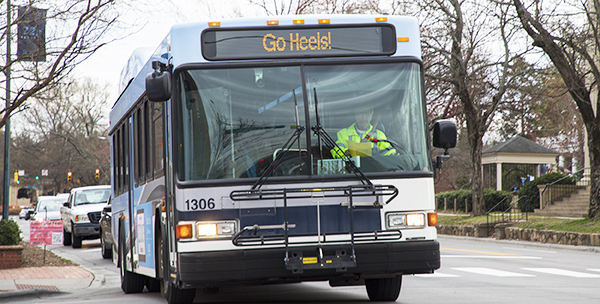
A Chapel Hill Transit bus. (Photo courtesy of GovDelivery)
The game at Ole Miss contrasts strongly with Cal’s last trip to the eastern part of the country, when the Bears traveled to Chapel Hill and defeated the North Carolina Tar Heels in the season opener two years ago.

I rode Amtrak’s Silver Star train from DC to Cary, NC the Friday evening before that 2017 game. I’d planned to get off in Raleigh and take GoTriangle buses to Chapel Hill, but due to some flash flood warnings the train pulled into the state capital behind schedule, after the last bus had left.

Thus, I stayed on the train until Cary (several miles closer to my destination, and the Silver Star’s last stop in the Research Triangle metro area before it turns south towards Florida) from where I unfortunately had to take Lyft to Chapel Hill. But once there, I had little difficulty getting around the college town on its fareless local bus system, which ran past bar closing time.

After Cal’s 35-30 victory the next afternoon, I took GoTriangle’s Route 400 bus up to Durham, paralleling the should-be light rail line  that Duke University, the Tar Heels’ rival, has obstructed for the time being. After hitting up a couple breweries in Durham, I hopped on an evening Megabus to DC, making it back in time to catch Metrobus’s 96 from Union Station.

My trip to Chapel Hill benefitted that region’s economy. Including food, drinks, lodging, and game tickets, I probably spent at least $250 there, helping support local jobs and keep business steady. I’ve also spoken positively about the experience to friends and family, spreading word-of-mouth that may inspire others to takes trips there, already or in the future.

Amtrak's Crescent train makes its daily stop in Tuscaloosa, home of Ole Miss's SEC West rival Alabama. (Photo courtesy of Tuscaloosa News)
Had I headed down to Oxford for this weekend’s game, I likely would have spent at least as much at that area’s businesses. But because a portion of those expenditures would have had to be on some form of car-based transportation, everyone lost.

Some may say that I’m the one missing out, claiming that a car would have given me “freedom” to get to and attend the game that other forms of mobility “cannot.” However, I see things from a different perspective: countless other college towns have safe, reliable, and affordable intercity mobility, while Oxford and Ole Miss have neglected their students, other residents, and visitors.

Every Pac-12 school – even Washington State, situated in remote Pullman – is located in a city or town with some form of intercity transit connectivity. It’s not perfect – for example, to get to Arizona State (situated in the Phoenix suburb of Tempe) by train, people must ride Amtrak’s three-day-per-week Sunset Limited to Maricopa, AZ, then transfer to a connecting bus – but at least the option is there.

Much of the Southeast is also better-connected than Oxford is. For example, if the Bears were instead playing Southern Miss in Hattiesburg, where an Aaron Rodgers-quarterbacked Cal team won an unexpectedly close regular season finale in 2004, I could enjoy a one-seat ride from DC on Amtrak’s Crescent. Other college towns the Crescent serves include Tuscaloosa, AL and Clemson, SC, home to the schools whose football teams have played each other for the national title three of the past four seasons.

An advertisement for Amtrak's state-supported Capitol Corridor route plays on California Memorial Stadium's scoreboard during a game. (Photo courtesy of mini, via TripAdvisor)
It’s been an exciting start to this season for the Cal football team. Two weeks ago, the Bears traveled to Seattle and, after waiting out a two-hour lightning delay, defeated a heavily-hyped Washington Huskies team 20-19. (Sound Transit and King County Metro extended rail and bus service that night to provide fans who stayed until 1:30am to see Cal’s Greg Thomas kick the winning field goal a reasonable way home.)

The past two seasons, however, Cal has lost its fourth game after winning its first three. It’s important for the Bears, led by their defensive backs known as the Takers, to maintain momentum this time.

But no matter what happens on the field, after the game the Cal team will get back on its charter buses, get out of Oxford, and return to a place with better mobility. The same cannot be said for the Rebels, who will have to deal with the consequences of a regional transportation plan that prioritizes automobile Level of Service above all else.            

Monday, September 16, 2019

How to protect transit service from the next recession

During the last recession, cuts to transit service left people without a safe, reliable, or affordable way of getting where they need to go. (Photo courtesy of St. Louis Post-Dispatch)
Even though public transportation didn’t cause the late-2000s recession, transit riders were devastated by the service cuts that resulted from it.

Now, as we near the end of another decade, economic indicators are pointing to the strong possibility of another recession. When the next recession does occur, transit providers – and the elected officials, from federal to local, who allocate funding to them – must prove that they’ve learned to weather it. If properly sustained, transit connectivity could even help soften the next recession’s blow to the public and protect our society from further harm.

The auto industry recovered from the recession. Why didn’t transit?

Transportation policy implemented as a response to the 2008 recession did protect certain jobs and benefit communities that otherwise would have faced greater short-term challenges than they did. But this policy also entrenched the shortcomings of our present-day mobility, as automobile interests enjoyed the lion’s share of the rewards from taxpayers.

For decades, the likes of General Motors and Chrysler had prioritized manufacturing of SUVs and pickup trucks, which earn the companies higher per-vehicle profit margins than standard automobiles despite their poor fuel efficiency. However, during the 2000s, gas prices rose and, though the prices remained well below actual fuel costs, consumers not only embraced smaller cars produced by foreign companies, but also rode transit in steadily rising numbers through the middle portion of the decade.

Predictably, the auto industry found itself in a quagmire when the recession hit.

However, because a lot of people work for car companies, the federal government gave the companies an $80 billion bailout ($12 billion of which was never paid back) to preserve the employment they provide. Additionally, to create construction jobs, $27.5 billion in stimulus funds went to the country’s road and highway system, which carries the cars the bailed-out corporations build.

Transportation modes that don’t involve cars did see support, but not to the same degree. The stimulus package included $8.4 billion for local transit and $9.3 billion for intercity rail.

The vast majority of the local transit funds were restricted to capital projects, rather than system operation. Accordingly, even as transit providers purchased new vehicles and built new tracks, they couldn’t afford to sustain their existing networks as the state and local funds their operating budgets depend on dried up due to the slow economy.

Deep cuts to transit service resulted, stunting ridership and revenue. Specifically, nearly three-quarters of U.S. transit agencies had either implemented or were considering service cuts by 2010. For example, the Pittsburgh area’s Port Authority of Allegheny County eliminated 15 percent of its bus service hours in March 2011. Los Angeles Metro, despite its ambitious rail goals, slashed 10 percent of its bus service, most of which it never restored.

Much of the intercity rail funding, meanwhile, fell victim to the polarized political environment surrounding U.S. transportation. Following elections in 2009 and 2010, nearly inaugurated governors Chris Christie (NJ), Scott Walker (WI), Rick Scott (FL), and John Kasich (OH) all cancelled large-scale rail projects and returned the federal dollars intended for them. The largest project to survive – California’s under-construction high-speed rail line – has also proceeded more slowly than it should have, largely due to lawsuits and political bickering.

Public transportation doesn't just provide connectivity. It puts people to work. (Photo courtesy of MPR News)
Though U.S. auto companies promised to focus more on vehicle fuel efficiency at the time they were bailed out, today they’re once again prioritizing SUVs and trucks in pursuit of profit. People who drive those vehicles still have to worry about sudden oil shocks stemming from Middle East strife. In the meantime, transit systems remain underutilized, underfunded, and stigmatized.   

Thus, when the next recession hits, public transportation should be treated as an essential form of connectivity that’s vital to the economy, rather than something that can simply be tossed aside in an attempt to balance a budget. 

Policymakers at all levels of government can take steps to ensure this happens.

A federal focus on underdeveloped parts of our transportation system would create jobs, both directly and indirectly

Over a half-century of federal appropriations have shaped how U.S. transportation infrastructure – and, accordingly, U.S. transportation culture – looks today. In the 1950s, our country’s leaders decided to construct a state-of-the-art highway network, and thanks to decades of sustained commitment, they succeeded. Though our roads and highways – in contrast to our transit – are now more or less built out, roads continue to receive four times as much federal formula funding as transit does.

The next recession’s stimulus package should put people first, prioritizing frequent, reliable transit over special interests and politics, as follows:

Increase capacity while preserving space: Road expansions don’t make it easier for people to get where they need to go, as added capacity is quickly consumed by more cars. Fortunately, there is a more effective and less disruptive way to increase capacity: re-purposing existing road space.

Protected bike and pedestrian infrastructure gives people more options for short trips – over 45 percent of present-day car trips are three miles or less in length – while dedicated transit rights of way provide a more reliable, less stressful way to reach destinations both near and far. There would also still be street space for people who drive, who would wind up at least as well off as if roads were widened.

Like road expansion projects, re-purposing of street space requires construction – creating jobs in line with a stimulus package’s objectives – but taxpayers would get much more bang for their buck. For one, dedicated transit lanes facilitate faster service, which boost a system’s financial performance through a combination of increased ridership and reduced operating costs. Benefits would extend beyond just improved connectivity, as mobility would become safer and healthier, public spaces would become more inviting, and we’d breathe cleaner air while making progress toward greenhouse gas emission reduction goals. 

Fund high-quality mobility, not just infrastructure: While transportation systems require infrastructure, vehicles, and other capital assets to function, effective mobility requires more than just steel and cement. For automobile-based modes, non-infrastructural necessities include car companies’ manufacturing, sales, and marketing arms; public-sector regulators who ensure cars adhere to safety and environmental standards and drivers are qualified to be behind the wheel; police who enforce the rules of the road; and first responders who save lives when cars crash.

Similarly, public transit systems require operating funds in order to connect people to their jobs, errands, medical appointments, and other life needs. Thus, in order for the next transportation stimulus package to tangibly benefit the public, a substantial portion of the funds must go toward transit operation.

As labor typically constitutes at least 70 percent of a system’s operating costs, the majority of this funding would be injected straight into the economy, sustaining stable, well-paying jobs. Other beneficiaries of the funds would include producers of the electricity, natural gas, and diesel that fuel our transit systems, as well as the fleet maintenance programs that keep those systems safe and reliable.    
  
Give states and localities flexibility, but make sure they stick to their plans: Since the last recession, another powerful car-based transportation industry has arisen: app-based ride-hailing.

Ride-hailing, like public transit, typically doesn’t earn enough revenue from fares to cover its operating costs. Infusions of venture capital – largely from traditional auto and oil companies – covered the industry’s losses for years. But now that the likes of Uber and Lyft are publicly traded, they’ll have to demonstrate they can earn profit to sustain stable operations. This will be challenging for them, especially if a recession strikes.

However, as ride-hailing gigs have become a source of income for many – Uber alone has an estimated 1.5 to 2.5 million drivers in the U.S. – it’s possible that, in the case a recession pushes the industry to the brink, firms will lobby for a federal bailout comparable to that the auto industry received in 2008.

However, driving for a ride hailing company is much different than working for a car manufacturer – while the latter provides relatively stable jobs, the former refuses to consider its workforce employees. In addition, it’s debatable whether the transportation ride-hailing companies provide, which has worsened traffic congestion and experienced significant safety issues, has benefitted our mobility. 

Thus, it should be up to states and localities to determine how ride-hailing should fit into their transportation networks, as well as how, if at all, taxpayer dollars should be used to optimize that fit. There’s already evidence that ride-hailing firms see contracts with transit providers as a path to profitability – a direction that would put them into competition with traditional transit contractors such as Transdev and First Transit, rather than transit systems themselves – and a recession may force them to restructure their operations more exclusively to that end. Metropolitan areas may be particularly interested in bolstering ride-hailing firms’ bike- and scooter-share arms, which in some cases have proven more popular than their car services.

But for larger-scale capital projects, states and localities that receive stimulus transit funds should be required to use those funds to achieve the objective they were intended for. Uncertainty stemming from political manipulation, such as that which stalled rail projects in 2009 and 2010, makes it incredibly difficult to plan and construct an effective transportation network. Thus, while practical adjustments to projects are a natural part of the planning process, any jurisdiction that opts to return already-obligated transit or intercity rail funds to the federal government without sufficient reason should be required to forfeit not just those funds, but also an equivalent portion of their formula-based highway allocation.

States and localities must embrace long-term goals

Though the above-described federal-level steps would catalyze widespread benefits, states and localities that wait for Congress and the president to act risk being let down. Fortunately, they also can take steps, independent of what happens nationally, to preserve and improve their mobility while bolstering their economies and creating jobs, as follows:

Consider the social, economic, and environmental impacts of service cuts: Before they can be built, proposed transit expansions must undergo extensive environmental review. This process can take years, and often becomes a tool transit opponents use to file lawsuits and stall much-needed projects.

Service cuts, on the other hand, are much easier to implement. Typically, a transit agency facing fiscal challenges will release a list of routes slated for elimination or reduction. They’ll then hold a couple public hearings at which riders of these routes can plead for mercy; the agency may then back off the original proposal slightly, but will still lay down the hammer in the end.

Title VI of the federal Civil Rights Act is one of few viable existing tools that transit advocates can use to fend off service cuts. But in order to be stopped using this mechanism, a cut must constitute obvious discrimination against minority or low-income riders – a high and unclear threshold. Typically, a transit agency can submit a back-of-the-envelope equity analysis to fulfill Title VI requirements; failure to conduct the proper analysis may result in a Federal Transit Administration request for more analysis, but actual service restoration is much less likely. Even if the analysis finds a proposed cut does constitute discrimination, the cut may just be restructured, rather than rescinded.

But service cuts cause much more serious environmental and social harm than a transit expansion. Thus, they should be subject to a review process that’s at least as stringent. A thorough analysis of a proposed cut’s impact on automobile vehicle miles traveled (VMT) and associated costs – such as fuel, maintenance, crashes, congestion, and emissions – would be a start. A more sophisticated process could extend beyond VMT analysis to also look at trips that simply wouldn’t happen if a proposed cut to transit was carried out, and the lost wages, time, and other adverse economic impacts that would result.

A more stringent review process protecting against transit service cuts could lead to numerous positive impacts for the public, including:
  • The costs of the review process could discourage officials from defaulting to transit service cuts and instead seek less harmful ways to balance the budget.
  • To create some middle ground, officials could streamline the environmental review standards transit expansions are held to, lowering those expansions’ costs and making them a more attractive recipient of future stimulus funds
  • In the long term, officials could analyze the reviews to quantify the level of transit service needed to provide adequate connectivity to residences, places of employment, and other life needs, establishing a sustainable transportation equivalent to automobile level of service (LOS) metrics.   

Align transit and land use to meet peoples’ needs: Service cuts are a form of corporate downsizing – transit officials hope to reduce costs while minimizing losses to revenue. Though systems are typically not designed to maximize ridership (such an approach would leave people who live in outlying areas without sufficient service), officials often cite ridership numbers when attempting to justify cuts. 

However, cuts make transit less competitive with other transportation options, causing ridership – and revenue – to decline sharply. As a result, transit providers often fail to achieve their budget-balancing goals through downsizing and may even resort to further cuts, furthering a destructive cycle.

Fortunately, there is a better option – strategies that boost revenue with only nominal effects on costs, in effect reducing the subsidies needed to provide transit service. There are two, interrelated ways of doing this: re-aligning transit networks to better match modern-day demand and adjusting land use policy to better integrate transit systems into the neighborhoods they serve.

Numerous regions have redesigned their bus systems in recent years, making them a more convenient way to get around amidst an increasingly competitive transportation sector. A recession would further push localities, especially those that have not yet pursued system redesigns, to re-discover the role of their transit systems:
  • Serve more than just 9-to-5 commutes: One of a transit system’s tasks is to move day-shift commuters from residential areas to employment centers in the morning, then back in the afternoon. However, such trips are just a portion of the connectivity people need. Across industries, workers’ shifts start and end throughout the day and night, and everyone also has 24-hour-a-day lives that involve a lot more than just their jobs. During a recession, when a relatively high portion of the population may be out of work and require transportation primarily for errands and their job searches, non-workplace connectivity is particularly essential.  
  • Keep up with expanding metropolises: Excessive sprawl presents a litany of challenges for transit providers. Perhaps the most pressing of these challenges is that if a metropolitan area expands outward, but the transit system doesn’t expand with it, the system will serve a smaller portion of peoples’ travel needs, leading to a decline in ridership even as population expands. Requiring new development projects to incorporate adequate transit connectivity, perhaps through a mechanism such as the sustainable equivalent to automobile LOS described above, would help mitigate this challenge and sustain revenue.
  • Put efficiency ahead of trendiness: In response to the rise of ride-hailing apps, a number of transit providers have made efforts to incorporate technology-based transportation into their systems. Some have directly subsidized certain types of trips on external ride-hailing networks, while others have started up their own internal app-based van services. In several cases, however, these programs have come at the expense of continuing or improving fixed-route bus service. Given that even the lowest-performing fixed routes typically move more people than ride hailing-style replacements for those routes, transit providers should thoroughly consider impacts to ridership and revenue, looking at alternative approaches (such as simply tweaking the alignment and stop locations of coverage-oriented fixed routes to provide more effective mobility) rather than blindly trying to keep up with ever-changing transportation trends.  

A transit system’s performance is influenced not just by the alignment of its routes, but also by the built environment that surrounds those routes. The adverse effects that common zoning regulations such as restrictions on height, use, and density, as well as parking minimums and car-based impact fees, have on transit ridership and revenue are well-known. Re-thinking these regulations helps broaden a system’s ridership base and, accordingly, its farebox recovery. In some cases, a transit provider can redevelop land it controls and even capture some of the value a system’s connectivity adds to the development projects surrounding it, further reducing the need for taxpayer subsidies.

More subtle tweaks to the built environment also can greatly increase the usefulness and performance of a transit system. Such tweaks include low-cost improvements to the places where riders board transit, such as installation of benches, shelters, and real-time arrival information, as well as ensuring people have safe, direct ways to walk or bike to transit stops.   

Act in the interests of people who ride transit: Public transportation agencies find themselves so vulnerable to short-term trends in part because some of the officials who govern our systems rarely ride them, and thus may not fully understand the role of transit connectivity in a person’s life. Given the power they have over an agency’s budget, such officials may be quick to resort to a service cut not because it furthers the system’s interests (as mentioned earlier, cuts are at best only a stopgap solution to an agency’s underlying financial problems) but rather because their power allows them to check a box that satisfies other, non-mobility interests.

Transit providers could address this issue by restructuring their boards or other means of governance to better represent riders. When budgetary challenges arise, rider-representative leaders would be more likely to focus on addressing the systemic issues that underlie funding shortages, rather than just cutting service. Also, to the extent that any changes affecting transit riders are necessary, such leaders would strive to implement them in a more equitable and user-friendly manner – for example, implementing a fare increase without making rider-hostile changes to the overall fare structure such as eliminating inter-route transfers. 

A transit-focused stimulus would make long-term life better

The benefits of preserving and improving transit service through a short-term recession would extend beyond just the immediate connectivity that service provides.

Good transit service makes it easier for people to access jobs, employers to recruit workers, and businesses to attract customers. All of these interactions help stimulate the economy, helping offset the negative effects of a broader downturn. In addition, for each new car people don’t feel compelled to purchase due to availability of better mobility options, more than $9,000 per year is freed up for people to spend in their communities, providing a boost for localities big and small, urban and rural.

Good transit service also represents a basic regard for life. Car crashes are not only lethal to people in vehicles, but also to people on foot or bicycle that have to share the streets with them.  Accordingly, minimizing the need to use and interact with cars gives people an opportunity to avoid this danger and maximize their contributions to the world.

And finally, good transit service today will help us sustain our civilization. If climate change is allowed to proceed unabated, the resulting harm to our economy and quality of life will eclipse anything our society has experienced in recent memory. Transportation is the U.S.’s biggest source of greenhouse gas emissions, and automobiles the biggest contributor to that source, so sustaining and bolstering transit – and the superior connectivity it provides – is perhaps the best way to reduce those emissions.

Saturday, August 3, 2019

An Alabama town’s ugly transportation past resurfaces in Hong Kong

Areawide Community Transportation System (ACTS) buses take on passengers at Anniston, AL's Amtrak station in July 2019. 58 years earlier, a Ku Klux Klan mob attacked the first racially-integrated intercity buses to serve the town. (Photo by me) 

Staring out the window of Amtrak’s New Orleans-bound Crescent train as it entered Anniston, AL on a recent Saturday, I caught a view of New Flyer of America’s recently-expanded bus factory.  The New Flyer factory gives Anniston, which lost 5.8 percent of its population from 2010 to 2017, a much-needed economic boost.

Transit agencies throughout the U.S. – including New York City Transit, whose Select Bus Service buses lined the facility as our train rolled past, and the Maryland Transit Administration, which recently spent $81.3 million on New Flyer buses now operating in Baltimore – supply funds that the factory’s 750 workers pass on to local businesses. 

A couple minutes past the factory, on the other side of the tracks, stood one of those businesses: an awning supply shop with two large Make America Great Again signs on its storefront.

As we pulled into Anniston Station, where Areawide Community Transportation System (ACTS) buses were taking on riders, I recalled the events of my prior trip on the Crescent, two years ago. That 2017 spring day – with DC Circulator buses lining the New Flyer facility – our train stopped just beyond Anniston due to a disabled Norfolk Southern freight train blocking the tracks ahead. We sat still for more than two hours before the conductor, having given up on a quick resolution to the problem, ordered our train back to the station, where we remained until the freight train was finally fixed.

A white passenger accosted a black Amtrak employee in the café car while we sat just west of town during that delay, exclaiming in a thick Southern accent that “everything’s wrong” while begging to be let off the train so she could drive to Birmingham, the next stop, for her afternoon religious service.

Greyhound buses in Birmingham, AL, as seen from Amtrak's Crescent train. (Photo by me)
In the spring of 1961, a lot was wrong in Anniston.

Six years earlier, the Interstate Commerce Commission had issued a ruling banning racial segregation on intercity transit, but had done nothing to enforce the ruling. So, the Freedom Riders – a mixed-race group of civil rights activists – took matters into their own hands, choosing their seats for a DC-to-New Orleans bus trip paralleling the Crescent route of today.

On Mother’s Day, a Greyhound with Freedom Riders aboard pulled into Anniston, the first of two passenger-desegregated buses heading into Alabama that day. However, a Ku Klux Klan mob – some members of which were clad in attire they had worn to religious services earlier that Sunday – attacked the bus during its stop at the downtown terminal, slashing its tires. Police, operating in collusion with the KKK, did little to restore order.

The bus made a quick departure, but only made it a few miles west of town before the Klan-inflicted damage rendered it disabled. The KKK mob, which has followed in pursuit, attempted to burn the bus with the riders trapped inside, then brutally beat them once they escaped. The riders made it to a local hospital, but received only minimal care as the mob surrounded the medical facilities. Allies from Birmingham had to come and rescue them, using a fleet of vehicles.

Freedom Riders aboard the second bus, which operated as part of the then-Greyhound competitor Trailways Transportation System, faced similar terror during their Anniston stop. Klansmen boarded, beat the riders to near unconsciousness, and dragged them to the back of the bus. The bus then continued to Birmingham, where upon arrival an even larger mob proceeded to beat the passengers with bats, pipes, and chains.

Despite the violence people aboard those first desegregated buses faced, Freedom Rides would continue for months. Later that year, the movement would catalyze a major Civil Rights accomplishment: full, enforced racial integration of intercity public transportation in the South.

Amtrak's Crescent passes wetlands near Lake Pontchartrain. (Photo by me)
58 years later, the Crescent would not be delayed in Anniston on this day. After a stop at the station – which now doubles as the town’s Greyhound terminal – that seemed shorter than the length of time it takes for the doors to open on a WMATA 7000-series train, the whistle sounded and we were on our way to Birmingham. (The downtown bus terminal at which the Freedom Riders were attacked still stands, preserved as part of a national monument President Obama established.) 

Shortly thereafter, I would – by the type of happenstance that can only happen in an Amtrak dining car – have lunch with Chef Madison Butler, the Rail Passengers’ Association intern spending the summer on a food-inspired cross-country rail trip, during her ride from Atlanta to Meridian, MS. That evening, stunning views of Lake Pontchartrain welcomed us into New Orleans, an hour behind the published schedule but on time for dinner at Acme Oyster House and a night of live music on Frenchmen Street.

A Lyft car at the front of a line of stopped vehicles near Frenchmen Street in New Orleans. (Photo by me)
I would encounter a spontaneous outdoor brass-band performance, on a street congested with ride-hailing vehicles. The chaos served as a reminder that the current state of mobility in New Orleans represents some of U.S. transportation policy’s greatest shortcomings – substantial funding went into construction of the short-line, mixed-traffic Loyola-Rampart Streetcar, but bus service levels remain approximately half what they were prior to Hurricane Katrina in 2005.

But on the other side of the globe, in a city-state that those of us trying to make it easier for people to get around places like New Orleans are infatuated with, a scene bearing eerie similarities to the KKK’s attacks on the Freedom Riders was playing out in a subway station.

Handmade signs implore drivers in New Orleans's Lower Ninth Ward, one of the hardest-hit neighborhoods during Hurricane Katrina, to slow down. Though 14 years have passed since the storm, the city has restored just half of its bus service. (Photo by me)  
Hong Kong’s Mass Transit Railway (MTR) is one of the world’s best transit systems. The city’s Rail + Property Model has both allowed the Hong Kong Stock Exchange-listed MTR Corporation to reinvest economic benefits the system provides city residents and businesses into further transit improvements, while also integrating stations and their surrounding neighborhoods so effectively that the system operates profitably. MTR has garnered such respect that transit providers from Sweden to Australia have contracted their operations to them.

On July 21, 2019, however, MTR’s Yuen Long Station looked a lot like Anniston’s bus terminal did on Mother’s Day 1961.

That day, hundreds of thousands of people had ridden MTR trains to attend the latest in a series of large protests against what they see as increasingly authoritarian behavior by the mainland Chinese government. Much like the Women’s Marches in U.S. cities the day after Donald Trump’s inauguration and the demonstrations in Seoul that catalyzed the impeachment of former South Korean president Park Geun-Hye, transit’s efficiency helped make Hong Kong’s massive gathering happen.

But after the rally, a white-clothed pro-China mob attacked riders aboard a packed train stopped at Yuen Long.  Using metal and wooden rods, the mob did not just attack people headed home from the protest, but beat those aboard indiscriminately. They injured people commuting home from late-evening work shifts, and even a pregnant woman.

Police did not arrive until a half hour after the attack, which an organized crime group carried out. Though local officials stated that the ongoing demonstrations had strained law enforcement resources, activists saw the slow response as evidence that those in charge knowingly allowed the mob violence to happen, much as Anniston authorities conspired with the KKK to terrorize the Freedom Riders.      

A New York City Transit bus at New Flyer of America's Anniston, AL factory. (Photo by me)
From Alabama towns to Asian megacities, public transportation gives people freedom of mobility. And in both, oppressive forces have resorted to violence against transit riders. The attackers in Hong Kong and Anniston had the same goal: to restrict the public’s freedom and spread fear.
          
Historically, when oppressors try to take on transit riders, they fail. In 1961, the KKK’s terror only steeled the resolve of the Freedom Riders, helping thrust the Civil Rights Movement into the national spotlight.

MTR now finds itself in a position comparable to that the American South’s intercity bus carriers did – a flashpoint of a major social and political movement. Earlier this week, protesters blocked train doors during a morning rush hour to express their condemnation of the attack, leading to crippling delays and bustitutions on the normally impeccable rail system. There’s also been talk of a train operators’ strike, which would likely cause even greater service disruptions.

It remains to be seen what long-term impact the Hong Kong demonstrations will have. But one thing is certain: violent mobs won’t scare people away from riding transit, or from fighting for what they believe in.          

Sunday, June 16, 2019

Transit is helping Yosemite address its big-city transportation challenges

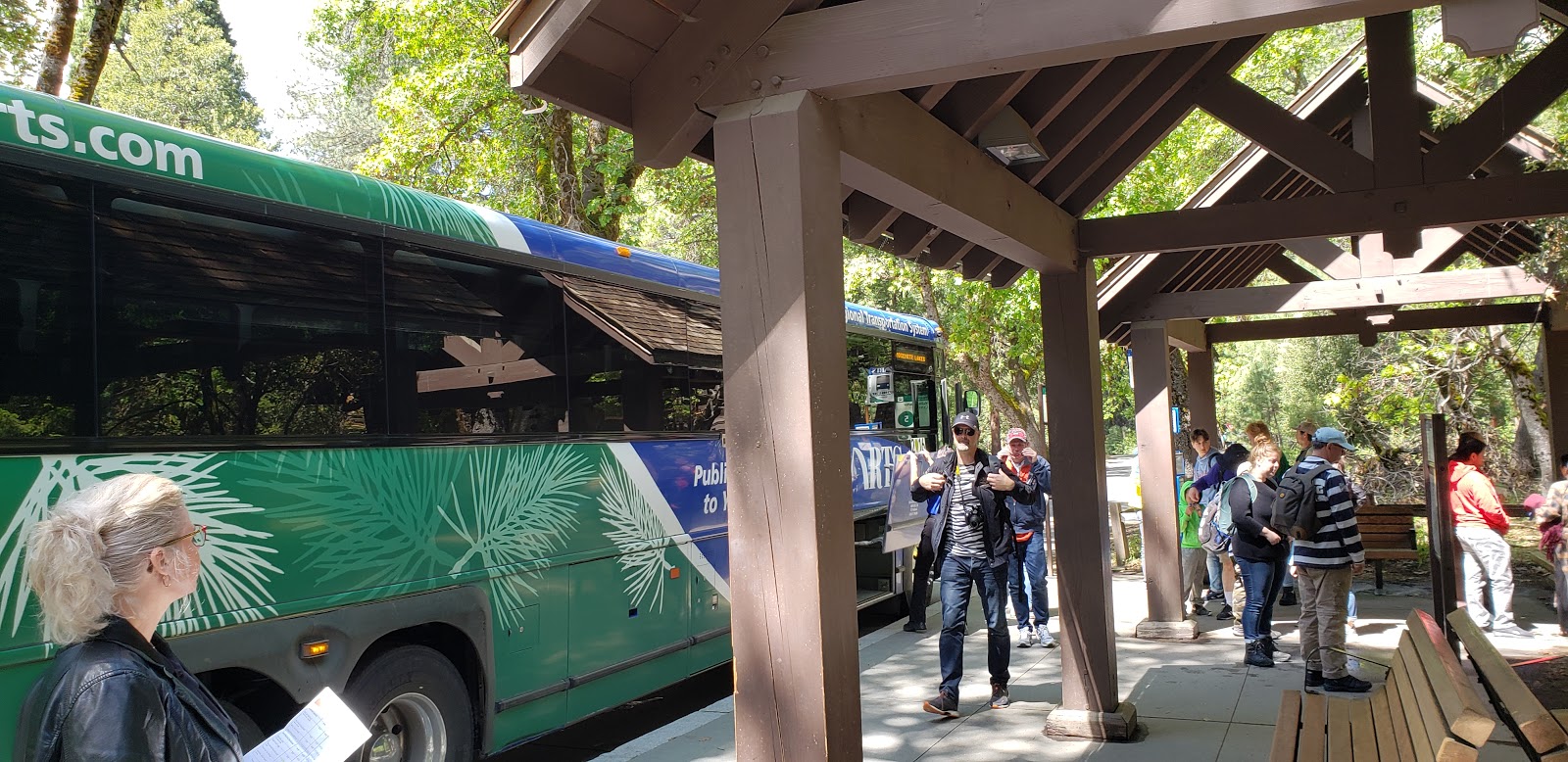
A Yosemite Area Regional Transportation System (YARTS) bus in Yosemite Valley. (Photo by me)
Because Yosemite National Park isn’t in the middle of a densely populated city, many in the U.S. transportation industry would say only bare-bones, lifeline transit service (if that, even) is necessary there. In contrast to DC’s Rock Creek Park, Yosemite lacks a rail system that people who climb El Capitan can use to get back to the bottom of the cliff.  

But a lot of people want to experience Yosemite’s world-class hiking, stunning vistas, and unique alpine scenery. And in recent years, it’s become clear that when too many of the California park’s five million-plus annual visitors attempt to access the park by car, all they’ll experience is misery. During peak periods, drivers can spend hours staring at taillights, only for park rangers to turn them away from the most popular areas before they can even exit their vehicles.

The geometric factors behind the park’s congestion problems mimic those that plague overly auto-dependent cities. Paving over meadows, forests, and streams to build more traffic lanes and parking lots wouldn’t alleviate the crush of cars, though some would-be visitors may find there’s plenty of asphalt to explore in their local strip mall and not even bother to make the trip.

Instead, the solution – just as in cities – is to prioritize more spatially efficient forms of mobility.

The basic elements of this solution are already in place. Core-capacity shuttle services carry per-mile ridership comparable to the country’s busiest transit systems, the regional Yosemite Area Regional Transportation System (YARTS) bus network covers all of the park’s main roads, and walking remains the only way to access backcountry areas.

Improving these options – which I utilized on a recent trip to the park – is the only way to ensure we can preserve and enjoy this precious national treasure.

Most of Yosemite is car-free, and always has been

A view of Yosemite Valley from the Yosemite Falls Trail. (Photo by me)
Despite the traffic congestion plaguing Yosemite Valley (where well-known landmarks including Yosemite Falls, El Capitan, and Half Dome are located) the vast majority of the national park is not accessible by car. The National Park Service (NPS)’s ingenious transportation demand management strategy: not building roads.

Instead, visitors must use the park’s 800 mile network of backcountry trails – which includes portions of the famous Pacific Crest and John Muir trails – to get to Yosemite’s most pristine areas. The trails feature plenty of strenuous sections, but also amenities that would make people in car-choked urban areas envious.

For example, though the top of Half Dome would only be accessible to skilled rock climbers in its natural state, two 400-foot-long cables lining the steepest section of the walkway make it possible for regular hikers to reach the summit. Though the trek still requires strength and stamina, at least hikers on Half Dome – in contrast to cyclists on most city streets in the U.S. – have something more than paint protecting them.

NPS also maintains six High Sierra Camps, each situated along remote sections of backcountry trail. These small communities, catering exclusively to people on foot or horseback, offer hikers cabin lodging and meal service. However, the camps’ accessibility is largely dictated by nature – this summer, for the second time in three years, the facilities won’t operate due to unusually heavy snowfall that prevented employees from conducting pre-season maintenance activities.

To allow visitors “outstanding opportunities for solitude,” NPS regulates Yosemite backcountry mobility much more strictly than it regulates automobile travel in the park (or on DC’s Rock Creek Parkway). Backpackers planning overnight stays in the wilderness must reserve permits months in advance to guarantee access to the highest-demand trailheads during peak tourism periods. Most day hikers are exempt from permitting requirements, though those wishing to attempt the aforementioned Half Dome hike must win a highly competitive NPS lottery before setting foot on the mountain.

Where there are roads, there’s bus service 

A Yosemite Valley shuttle bus crosses a congested road. (Photo by me)
As the acting director of NPS in early 2017, Michael Reynolds fielded an angry phone call from Donald Trump after the agency retweeted photos showing the sparse size of the president’s inauguration crowd. Now, as the superintendent of Yosemite, Reynolds is in charge of the park’s efforts to safely and efficiently handle its record-breaking crowds.

In a 2018 interview with the Fresno Bee, Reynolds provided an excellent summary of the transportation-geometry relationship, explaining that it’s not the large number of visitors to Yosemite Valley that’s the problem, but the fact that many of them are using a form of mobility that there simply isn’t space for.

“The issue here is cars,” the Bee quoted him saying. “An awful lot of cars in a small space, all at one time.”

Reynolds was oddly defeatist, however, when discussing the possibility of better transportation options. According to the Bee article, he said the park “does not have the infrastructure” for a regional bus system providing connectivity between the valley and communities outside the park. He also cringeworthily told the San Francisco Chronicle that an “Uber culture” could help solve the park’s traffic problems.

A Sonora-bound YARTS bus ascends a hail-covered road out of Yosemite Valley. Good thing we weren't driving! (Photo by me)
Fortunately, the superintendent doesn’t need to design a completely new bus system – because one is already there. He’d be well-advised to try that system – YARTS – out sometime.

YARTS started service in 2000, and originally was primarily a lifeline transportation option for park employees. The system, whose four routes operate between Yosemite Valley and the termini of Merced, Fresno, Mammoth Lakes, and Sonora (serving towns, trailheads, and lodging along all of the park’s main roads), still fulfills that essential role. But as it has expanded, park visitors have also used it more and more, with ridership up 50 percent over the last 14 years. Today, more than 100,000 people ride YARTS annually.

Over Memorial Day weekend, I took a day trip on the Sonora route from Rush Creek Lodge (a hotel just outside the park entrance) into Yosemite Valley. Our hour-long mid-morning ride in went smoothly, with the exception of a brief delay to let a bear cross State Route 120. A bus lane through congested portions of the valley aided our travel.

We then hiked for several hours, making it much of the way up the Yosemite Falls Trail. But as we finished our packed-in lunches, thunderclouds loomed. We quickly descended the exposed, switchbacked trail, caught a circulator bus, and headed into The Loft at Degnan’s for a couple beers before catching our afternoon bus back to Rush Creek. By the time we boarded, the weather had deteriorated, but our bus driver calmly and safely ascended the grade out of the valley through an intense hailstorm.  
     
YARTS operates using intercity-style coach buses, with restrooms on board and space for luggage such as hiking and camping gear. Riders can pay their fares when they board – as we did – or can reserve a seat in advance. During particularly busy times of year, the transit system waives fares on some days.

YARTS has made efforts to integrate its transit services with those of peer transportation providers. At the stop in Yosemite Valley, riders can transfer to the aforementioned circulator shuttle system, which has two routes, serves numerous popular destinations, and is fareless. The shuttles are quite crowded, carrying nearly 4,000 passengers per mile of route length – a load factor comparable to that of San Francisco’s Muni. The valley also offers a network of separated bike-pedestrian paths and – starting last year – a dockless bikeshare system.

Outside the national park, YARTS connects to several other regional and intercity transit systems. Riders transferring from Amtrak’s San Joaquins train route (in Merced and Fresno) and Greyhound buses (also in Merced) can purchase through tickets, facilitating travel from locations such as Los Angeles, San Francisco, and Sacramento on a single fare. Also, YARTS offers United Airlines passengers free transfers to YARTS’s Fresno and Mammoth Lakes routes, encouraging visitors flying into Yosemite’s two closest airports that serve major airlines to take the bus to the park. 

And starting next decade, existing YARTS bus routes will connect to the initial operating segment of California’s currently under-construction high-speed rail system in Merced and Fresno, as well as to a Merced extension of the Altamont Corridor Express (ACE) rail system.  
      
While Yosemite has plenty to learn, in the future cities may also learn from Yosemite

Despite all the progress YARTS has made over the last two decades, only two percent of Yosemite visitors arrive by transit, demonstrating that there is a lot of room for improvement.

The existing YARTS system is designed primarily to get people to and from Yosemite Valley, and its timetables strongly resemble those of “commuter” rail or bus systems intended to give people living in outlying parts of metropolitan areas an "alternative" way of getting to and from downtown, with the valley taking the place of the city center. As a result, it can be challenging to plan a transit-based day trip to other must-see (though less car-congested) parts of the park, such as Tuolumne Meadows or Mariposa Grove. Also, the YARTS system is largely seasonal – only the Merced route operates year-round, with service on the other three routes limited to the peak late spring, summer, and early fall tourism periods.

Furthermore, infrastructural issues outside of YARTS’s control limit its ability to serve the region. For example, while (as mentioned earlier) there are bus lanes in Yosemite Valley, there are no such lanes at the park entrances, rendering passengers susceptible to delays caused by long queues of single-occupancy vehicles. Also, NPS does not plow Tioga Pass Road – which carries the Mammoth Lakes route – during snowy periods, preventing YARTS from providing a valuable connection between Yosemite Valley and the famous Mammoth Mountain ski resort during the winter. And the fastest road for automobiles up the Priest Grade, a segment of the Sonora route, is very steep and not maintained to standards adequate for bus service, forcing YARTS riders onto a windier, more circuitous road that’s ten minutes slower.

The view from Rush Creek Lodge, located just outside Yosemite, after a late-May snowstorm. High-elevation weather patterns pose a challenge to transit providers. (Photo by me)
Despite these challenges, plenty of factors indicate a promising future for YARTS.

For one, despite the small percentage of Yosemite visitors that arrive via transit buses, the portion entering the park on any type of bus – including charter buses – is a much greater 9 percent of total entrants, or about 500,000 people. Many of the charter bus passengers could well prefer to take transit – which should offer them more freedom than a guided tour – but may not know YARTS is an option, or may not find the system sufficiently frequent or extensive to meet their needs.

In some ways, YARTS has more going for it than urban transit agencies do. Specifically, improvements to transit in Yosemite – such as increased service frequencies, more year-round service, and routes and schedules designed to facilitate access to all parts of the area roads serve (rather than just Yosemite Valley) – may be less susceptible to the three primary types of harmful transit opposition, as follows:

Car culture:  The auto industry has had a strong influence on American transportation culture, and as a result cars seem to dictate everything from the way our infrastructure is engineered to a person’s social status. Accordingly, many people are hesitant to embrace other methods of getting around.

However, Yosemite is a place people – from urbanists to car aficionados – go to experience the outdoors, not to sit in traffic. For hikers and backpackers, it can be preferable to start and end a trip at different locations (possible by transit) than to return to the origin (required if driving). Furthermore, in contrast to many city centers, people are already accustomed to paying to drive into Yosemite, so tools such as congestion pricing could be framed as beneficial tweaks to the existing toll system. 

NIMBYism:  In metropolitan areas, transit projects connecting major activity centers often face opposition from local residents and business owners who fear change or believe in false stereotypes. This opposition often causes projects to be scaled back, rerouted to the point that their would-be benefits are largely negated, or even cancelled entirely.

But despite how crowded Yosemite can get, only a small number of people live there. Environmental preservationists concerned about impacts on local resources will likely welcome transit improvements and other changes that could reduce driving and help sustain the park’s scenery, rather than oppose those improvements on NIMBY grounds.

Also, in spite of the park’s superintendent’s aforementioned Uber references, the area’s small population and spotty cell phone service render congestion-worsening ride hailing impractical.  

Funding:  New transit infrastructure is expensive to construct, especially in the U.S, and it can be challenging to obtain the necessary funds. However, YARTS service increases would require primarily new buses and drivers, rather than new rights of way, reducing the potential of excessive scrutiny.

Furthermore, California already has relatively good intercity rail and bus service (by U.S. standards), so YARTS can take advantage of infrastructure elsewhere in the state. For example, YARTS hired a consultant to study the possibility of system expansions, but an extension to the San Francisco Bay Area was deemed unnecessary because a well-timed San Joaquins rail connection is already in place. The study instead recommended YARTS prioritize improvements on its existing routes and consider extending its Sonora route to Sacramento via Stockton, which would provide additional connections and help fill a gap in the state’s transportation system.

***

Transit can be a mainstream form of mobility in a national park. The strong ridership on Yosemite Valley’s circulator shuttle system, as well as a comparable local shuttle network serving Zion National Park in Utah (which began service the same year YARTS did, operates as frequently as every four minutes on largely car-free roads, and carries more than 6 million annual riders) demonstrates this.  

However, YARTS has the potential to be a primary way for people to both get to the Yosemite region and move around the region once there, exceeding the Yosemite Valley and Zion systems’ primarily local functionality. To expand transit’s role in the Yosemite area, officials should treat YARTS as they have the park’s backcountry trail network – as mobility, rather than just an alternative to driving and parking. 

If YARTS and the jurisdictions that govern it can seize this opportunity, they not only would help people rediscover Yosemite the way it was meant to be seen, but could also play a part in fixing mobility in other places. If people travel to Yosemite and have positive, car-free transportation experiences there, they may wish to replicate those experiences back home.